



 +34 966 497 016
 +34 663 30 61 74


 Continue with Google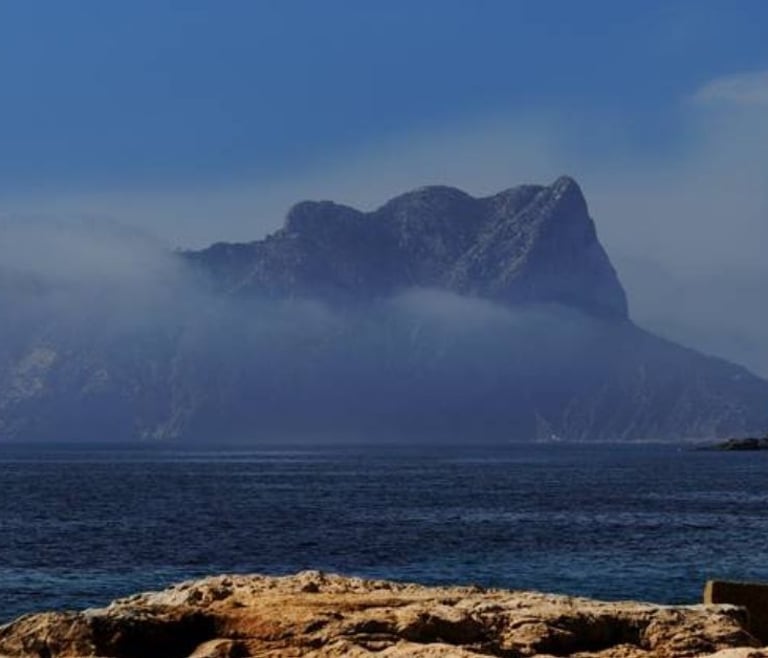
Things to see and do in Benitachell
Things to see and do in Benitachell
When we talk about what to see and do in Benitachell, the best sunsets come to mind, as they are undoubtedly in the Mediterranean Sea. Kilometers of coast and wide beaches that are visited each year by thousands of tourists, both nationals and internationals. Travelers seeking good weather, great cuisine, and a combination of peace and entertainment.
And if there is a point that stands out along the entire Levantine coast, that is the region of Marina, in the north of Alicante province. A series of municipalities that live for and from the tourists, with the blue of their sea as the main attraction. La Marina Alta and La Marina Baja form a unique environment of stunning beaches and an excellent destination for spending long or short days under the sun.
With two kilometers of coast, for example, one of the lesser-known but no less attractive spots is the municipality of Benitachell. Located close to tourist hotspots in Alicante such as Jávea or Teulada, it covers just over 12 square kilometers and offers a good number of things to see in Benitachell that satisfy diverse tastes of visitors.
What to see in Benitachell
Origins
El Poble Nou de Benitachell has a rich cultural history. Different peoples have passed through the area, leaving traces of their architecture that can still be seen in various parts of the town.
The earliest signs of occupation in the area date back to the Paleolithic and Calcolithic periods (2000 BC), according to studies conducted at the Cova del Moro and els Forats del Barranc de l'Asbardal. Remains from the Bronze Age (1800 BC - 700 BC) and the Iberian era (550 BC - 210 BC) have also been found at Tossal de l'Abiar or Cova de les Bruixes. Additionally, evidence from the Roman era (210 BC - 476 AD) and subsequent Islamic and Christian constructions have been identified.
Ultimately, Benitachell has always been a privileged settlement for the various cultures that have inhabited it, mainly due to its seaside location and the presence of underground waters that favored agricultural exploitation.
El Poble Nou was founded in 1244 when the troops of Jaume I conquered Dénia and its territory, leading to population growth over the following centuries. Remains of all these cultures can still be seen in Benitachell.
Monuments
Throughout Benitachell, there are various monuments that showcase part of the tradition mentioned earlier. Places like the Town Hall, the Portalet, Santa María Magdalena Church, and the Jaime Llobell Oratory are some examples of Christian constructions still standing today.
Firstly, the current Town Hall was inaugurated in 1988, but previously municipal schools were located on the site. It still displays the old town crest.
The Portalet was the gate that provided access to the Church square, one of the entrances to the walled core of the original village, from which a beautiful viewpoint overlooks Montgó and the bay of Xàbia.
The Santa María Magdalena Church was built between 1710 and 1774. Although it has undergone renovations, it remains a good example of the architecture of the period, with a great austerity on the exterior and interior ornamentation, featuring Baroque style with Neoclassical elements.
The Jaime Llobell Oratory was constructed in the late 19th century when the priest after whom it is named founded the building to help those in need. It was damaged during the Civil War but was restored and reopened for worship in 1974.
Traditional architecture
There are various traditional corners still present in Benitachell, from quarries to caves and wells. Here's a brief overview of some of them.
In 2018, a limestone quarry from the Roman era was discovered during the rehabilitation work on the Serp-Puig de la Llorença-Cala Llebeig trail, one of the hiking routes available in the area. It offers a good example of how stone was worked during that period.
Regarding caves, several are found along the cliffed coastline, along the route of the Penya-segats trail. These are dry-stone constructed caves attached to the cliffs, dating from the late 19th and early 20th centuries.
These caves were used by local fishermen and farmers, but also by smugglers. Notable caves include Cova les Morretes, above Cala del Moraig, which has a bread oven; Cova del "ti Domingo l'Abiar", very close to the previous, served as a shelter for fishermen; Cova de "Pepet del Morret", on the same cliff as the previous two, which features a space where fires were made, with some stones used as makeshift chairs and tables; passing through the small tunnel visible from the previous cave, you reach Cova del "ti Toni el Senyalat", one of the largest, with different stone ledges inside. Lastly, Cova del Morro del Bou, near Cala Llebeig, is still occasionally used by fishermen.
Els Pous de l'Abiar is another example of traditional architecture. It consists of a network of underground wells and tanks that collect water from the lower part of the Albiar. A windmill, used as a natural water source, is preserved. Until the 1990s, these wells served as water and irrigation sources for the area.
In this area, there was also a public washhouse used by local women, who went there to do laundry, taking advantage of water collected in the wells. It was operational until the 1970s.
Finally, the riurau is the oldest architectural structure in Poble Nou. It was used to store raisins and was a typical construction across the region, allowing Poble Nou de Benitatxell to be part of the Marina Alta's efforts to preserve this type of building.
Natural spaces
Benitachell is full of natural areas worth visiting, whether heading to specific sites or exploring various hiking routes.
The Cova dels Arcs is an example of space carved by the sea that has survived over the years. The entrance is next to Cala del Moraig; definitely worth seeing if you visit the area.
The geological movement created the Moraig fault, a nearly vertical rocky wall worth seeing, which appears to hover over the lagoon providing access to the Riu Blanc, which we will discuss next.
El Riu Blanc is an underground river very close to the Cova dels Arcs. It is a wide gallery of 2 kilometers of submerged tunnels that reach depths of up to 60 meters underwater, with its outlet near the Fault. Studies have concluded that water flows from Altea and Calpe toward this area. This is a unique phenomenon in the world, occurring only in a Greek island.
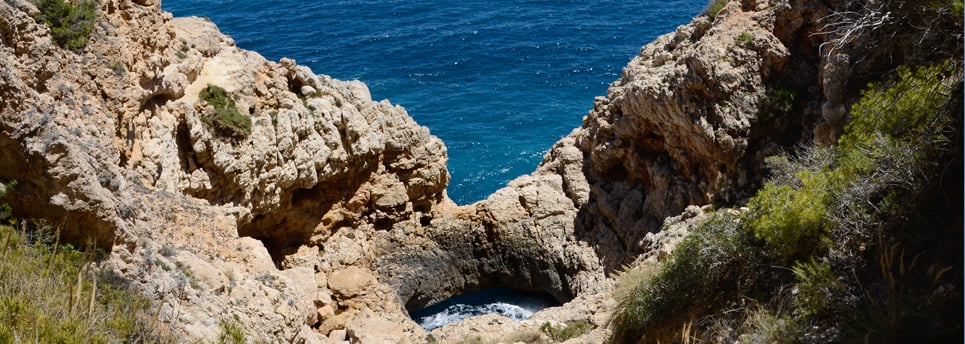
La Vasenilla is a deep depression near the coast with almost vertical walls forming a circular basin. It connects with the sea but is not yet open to it; when it is, it will become a cove.
Archaeological sites
If you're interested in archaeological sites, at Cova de les Bruixes you can observe the passage of all cultures that have passed through the municipality.
Benitachell coves
The rugged coast and its rough waters give these coves great appeal, such as les Testos, with its shingle beach, Llebeig, and Moraig, nestled in nature and close to stunning rental homes in Benitachell. But the attractions of Benitachell don’t end here; its urban core hides real gems that add a special charm typical of Mediterranean villages.
What to do in Benitachell
And it's not only about what to see in Benitachell; there are also many activities. An increasing number of visitors choose to rent houses in this town for water sports, thanks to its rich marine life, and also for hiking. The natural environment is abundant, with routes like the Cliffs, the Fault, the Barranco dels Testos, and the Submarine trail gaining more enthusiasts every day.
At Villas Guzmán, we offer apartments and fully equipped vacation homes so you can explore the Alicante coast without any hassle.
Photographs sourced from
http://www.turismo.elpoblenoudebenitatxell.com/es/

 Exclusive
 3 bed.
  5
5

 Recommended
 3,0 km


